
Why Most Music Appreciation Curriculum Plans Don’t Work
If you’ve ever felt like your music appreciation curriculum isn’t quite landing with your music students, you’re not alone.
Many music teachers are working with:
- Limited time
- Mixed ability classes
- Inconsistent resources
- No clear structure across the year
And the result?
Students complete activities… but they don’t actually understand the music or see the “big” musical picture.
When I first started teaching back in 2001, I was a casual teacher thrown into classrooms from Grades 7 to 12 with very little guidance. There was no clear music appreciation curriculum, no assessment structure, and no real direction—just a booklet and 80-minute lessons to fill.
I spent hours creating resources just to get through each lesson.
Then I moved schools… and it was the same story again.
Better resources—but still:
- No differentiation
- Limited engagement
- Students barely touching instruments
It wasn’t until I started building my own structured approach that things changed.
If you’re looking for an example of what a structured, ready-to-teach program can look like, you can see the full curriculum I now use here:
Music History Curriculum Bundle Lessons Activities Middle School General Music
Why a Strong Music Appreciation Curriculum Matters for Student Learning
A well-planned music appreciation curriculum does more than fill lesson time.
It helps music students to:
- Understand what they are hearing
- Use correct music vocabulary
- Make connections between styles, genres, and contexts
- Build confidence across performance, listening, and composition
Most importantly, it creates lesson consistency.
When students experience the same music lesson structure across units, they:
- Know what to expect
- Build skills step by step
- Improve their ability to analyse and describe music
This is where real learning starts to happen.
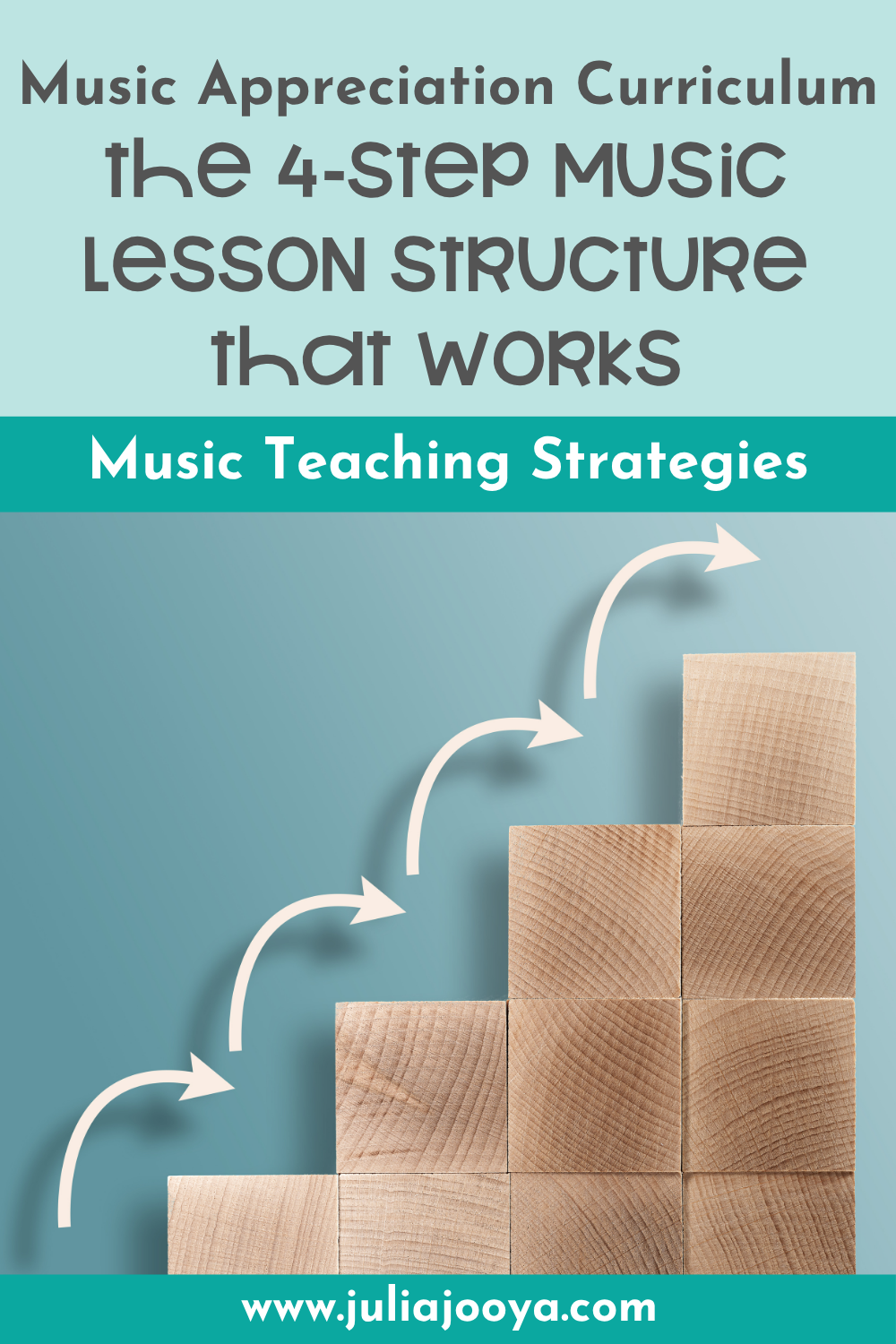
The 4-Step Music Appreciation Curriculum That Actually Works
Instead of trying to reinvent every unit, the key is to use a repeatable lesson structure.
Here’s the approach that has consistently worked in my own music classrooms:
Step 1 – Music Vocabulary
Students learn the key terms and concepts needed to describe music for the Elements of Music
Step 2 – Listening Skills
Students focus on what to listen for:
- Instruments
- Elements of music
- Musical features
Step 3 – Music Analysis and Writing
Students describe music using structured frameworks like M.U.S.I.C.
Step 4 – Music History and Genre Study
Students apply their knowledge to real music through units based on:
- Genres
- Artists and composers
- Cultural context
This is exactly how the music lessons are structured inside my curriculum bundle—each stage builds on the next so students aren’t just completing activities, they’re actually learning how to think about music.
You can take a closer look here:
Music History Curriculum Bundle Lessons Activities Middle School General Music
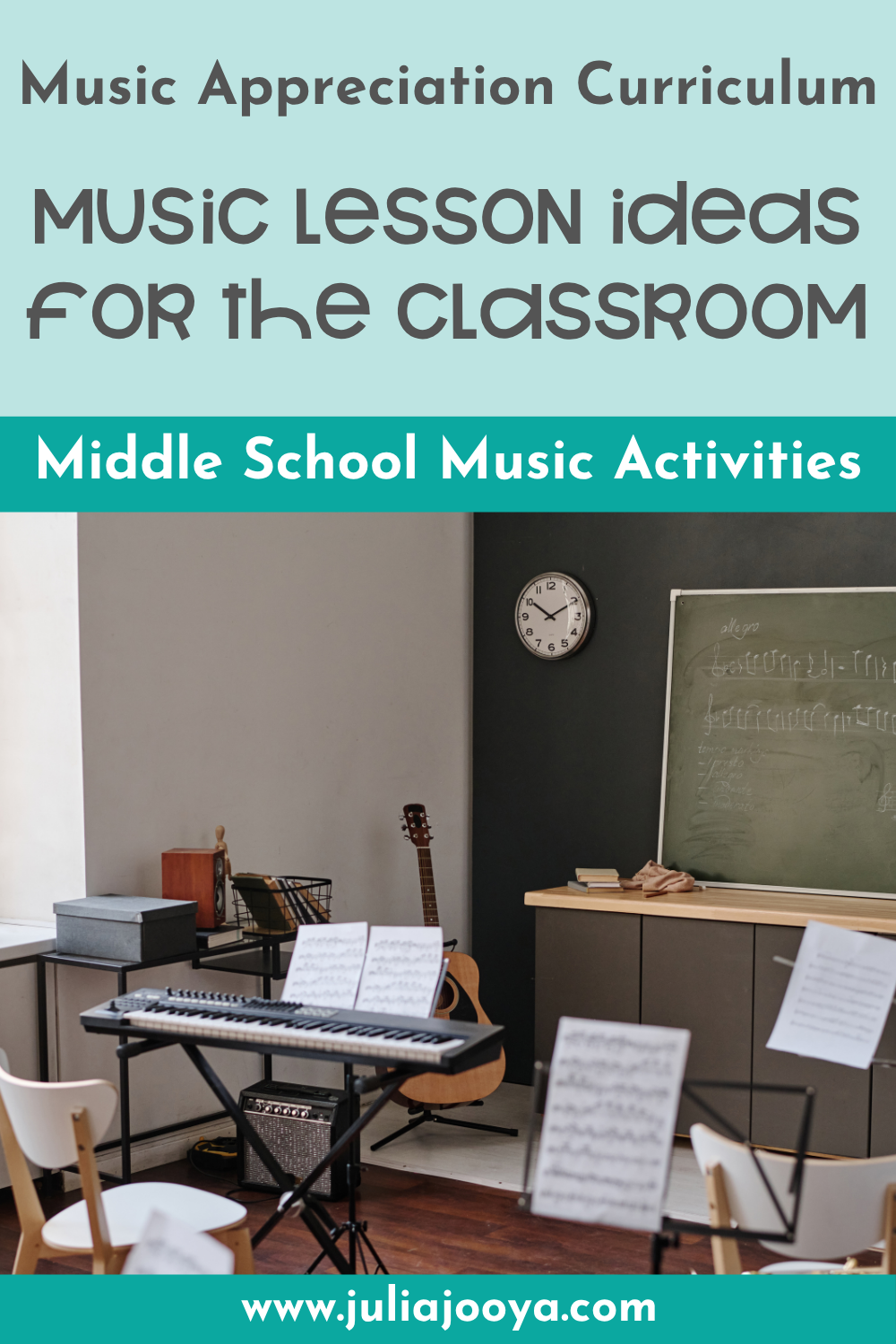
What This Music Appreciation Curriculum Looks Like in a Real Music Classroom
For my own music classes, I teach from Grades 7 to 12, and below is the teaching order that I use to teach each unit from the Music History Curriculum Bundle Lessons Activities Middle School General Music
Grade 7
- Rhythm and Rap
- Instruments of the Orchestra
- Film Music
Grade 8
- World Music or African and Jazz Music
- Instruments of Rock
- Rock Music History
- Pop and Roc Musicians
Grade 9
- Australian Music
- Small Ensembles
Grade 10
- Jazz Music
- 1980s Music Era
Across all of these units, I teach the Elements of Music in context of the music that is being studied. If you want to know more about the 8 Elements of Music read this blog post here-What are the 8 Elements of Music?
I don’t try to teach everything at once. Instead, I focus on the elements that make sense for each unit.
For example:
- Film Music → Timbre, Dynamics, Pitch and Tonality
- African Music → Rhythm, Texture
- Rock Music → Structure, Timbre, Structure
By the end of each school year, students have covered all elements of music — without overwhelm.
These are the exact types of units included in the full curriculum bundle, designed to be flexible depending on your students and your context.
How to Structure Your Music Appreciation Curriculum Across Units
This is where most teachers get stuck.
This approach is not about copying the same units.
It’s about using a teaching lesson structure you can apply to anything.
1. Start with the Unit → Anchor the Learning
Choose your topic:
- Genre
- Style
- Context
Then decide which elements of music fit naturally.
Don’t force everything into every unit, teach what makes sense and what your music students need to learn to understand what is being studied.
-
Build Across the 3 Skill Areas
Every unit should include learning activities for:
- Performance
- Listening
- Composition
For example:
- Performance → playing or rehearsing
- Listening → analysing using elements
- Composition → creating within the style
- Align Assessment (Keep It Simple and Consistent)
Here in the state of Australia that I teach in, we are limited to 3 assessments per year, so I combine skills:
- Task 1 → Performance + Composition
- Task 2 → Performance + Listening
- Task 3 → Listening + Composition
This same structure is built into my teaching resources so you’re not starting from scratch each time you plan a unit.
You’re right to call this out—this section needs to teach, not just list.
Right now it names the problems.
What we want is:
“I see myself in this… and now I know what to do instead.”
Here’s a stronger, more “meaty” version you can drop straight in:
Common Mistakes When Planning a Music Appreciation Curriculum
Let’s be honest—these are easy traps to fall into, especially when you’re trying to juggle content, engagement, and assessment all at once.
1. Trying to Teach All Elements at Once
It feels logical to cover all the elements of music in every unit.
But what actually happens?
Students become overwhelmed, and their understanding stays surface-level.
Instead of learning deeply, they end up recognising terms… but not really understanding how they work in music.
What to do instead:
Focus on the elements that naturally fit the unit.
For example:
- Film Music → Timbre, Dynamics, Structure
- African Music → Rhythm, Texture
- Rock Music → Structure, Tone Colour
Students don’t need everything at once.
They need clear focus and repeated exposure over time.
This allows students to build deeper understanding—and over the course of the year, they still cover everything.
-
Teaching Units with No Clear Focus
Sometimes music units are built around a musical style, genre or topic—but not around learning.
This is one of the biggest reasons a music appreciation curriculum feels “all over the place.”
You might have:
- A great listening activity
- A worksheet
- A performance task
…but no clear connection between them.
So students complete the work, but don’t understand why they are doing it.
What to do instead:
Start every teaching unit with a clear focus:
- What is the musical concept I want my students to know?
- What do I want students to understand by the end?
- Which elements of music are you targeting?
- What should students be able to hear, say, or do by the end?
Then make sure every activity connects back to that focus.
When this is clear, everything else falls into place.
-
Separating Performance, Listening, and Composition
This is a really common one—and it’s often built into how music teaching programs are written.
You end up with:
- A performance task in one part of the term
- A listening task somewhere else
- A composition task later on
The problem?
Students never connect the key musical skills and ideas.
They don’t see how what they play, what they hear, and what they create all link together.
What to do instead:
Combine the skill areas within each unit.
For example, within a single unit, students might:
- Learn about a style and listen to examples
- Perform music in that style to build practical understanding
- Analyse what they hear using the elements of music
- Compose their own piece to apply and reinforce their learning
This approach ensures that performance, listening, and composition are not taught separately, but work together to deepen understanding.
-
Overcomplicating Assessment Tasks
It’s very easy to design assessment tasks that look impressive on paper… but are overwhelming for students (and time-consuming to mark).
This often leads to:
- Confused students
- Incomplete submissions
- Increased marking load
What to do instead:
Keep your music assessment structure simple and consistent.
In my own music classroom, I use:
- Task 1 → Performance + Composition
- Task 2 → Performance + Listening
- Task 3 → Listening + Composition
My music students know what to expect, and I’m not reinventing the wheel every term.
-
Relying on Activities Instead of a Structured Music Appreciation Curriculum
This is the big one.
It’s very easy to fall into the cycle of:
“I just need something for tomorrow’s music lesson”
So you grab:
- A worksheet
- A YouTube video
- A quick activity
And while these can be useful, they don’t build long-term understanding on their own.
What to do instead:
Work from a clear structure (like the 4-step approach in this post), and then choose activities that support it.
This is the shift from:
doing activities
to
building a music appreciation curriculum
Why Does Having a Music Appreciation Curriculum Matter?
If your music lessons have ever felt disconnected, repetitive, or harder to manage than they should be—it’s usually not a content problem.
It’s a structural problem.
Once your music appreciation curriculum has a clear, repeatable teaching and learning structure:
- Your lesson planning becomes faster
- Your music appreciation lessons feel more purposeful
- Your music students start making real connections in their learning
How to Differentiate Your Music Appreciation Curriculum Without Extra Work
Differentiation doesn’t need to mean creating completely different lessons.
In fact, the most effective differentiation happens when:
all students are working on the same concept, but with different levels of support and application.
Start with the Same Learning Goal
In every unit, students are still:
- listening
- performing
- composing
The difference is how they access the task.
Use Simple Differentiation Strategies That Actually Work
You can adjust your lessons quickly by:
- Using sentence starters or structured scaffolds (like M.U.S.I.C.) for students who need support
- Providing levelled listening questions (short answers vs extended responses)
- Offering scaffolded vs open-ended composition tasks
- Keeping the same activity, but changing the level of independence
Connect Practical Activities to Composition (This Is the Key Shift)
This is where differentiation becomes really powerful.
Instead of treating performance as a separate activity, use it as a bridge into composition.
For example:
- Students learn a rhythm pattern → then create their own variation
- Students perform a chord progression → then arrange it into a song structure
- Students play a groove or ostinato → then layer or develop it into a composition
Same starting point. Different levels of complexity.
- Some students might copy and slightly adapt
- Others might extend, layer, and structure their ideas
This allows every student to participate successfully—while still being challenged.
Use Instruments as a Differentiation Tool (Not a Barrier)
In my classroom, the instruments and practical activities change depending on the year group and what is available:
- Grade 7 → body percussion, bucket drumming, keyboard
- Grade 8 → djembe, ukulele, guitar
- Grade 9 → student choice
But the structure stays the same.
Students are always:
- performing
- listening
- creating
The instrument simply becomes the teaching tool—not the limitation.
Differentiate Through Delivery (Not Just the Task)
Another simple way to differentiate is through how the lesson is delivered.
For example:
- Listening activities can be:
- completed independently
- guided in small groups
- or taught as a whole class
- You can also:
- assign specific questions to different students
- reduce or extend the number of tasks
- adjust the level of teacher support
You already know what your students can and can’t do—this is where you make it work for them so they experience success.
Why This Approach Works
When differentiation is built into the structure:
- students feel more confident
- behaviour improves
- and learning becomes more consistent
You’re not creating multiple lessons.
You’re creating one strong lesson with multiple entry points.
This is exactly how the resources in my curriculum bundle are designed—flexible enough to adapt to different ability levels, while still keeping the same learning structure in place:
Music History Curriculum Bundle

Choosing Resources That Support Your Music Appreciation Curriculum
Here’s the key shift you need to consider:
Your music appreciation teaching resources should support your teaching program structure—not dictate it.
The best resources:
- Work with any piece of music
- Can be reused across units
- Support multiple ability levels
- Reduce planning time
This is exactly why I created my Music History Curriculum Bundle.
It includes:
- Teaching slides
- Printable and digital versions
- Reading passages and worksheets
- Music vocabulary activities
- Listening and analysis tasks
- Writing scaffolds (M.U.S.I.C.)
How This Music Appreciation Curriculum Fits Into Your Music Teaching Cycle
All the music appreciation units in this bundle supports the full music learning process:
- Vocabulary → understanding
- Listening → identifying
- Analysis → explaining
- History → applying
Instead of disconnected music lessons, students experience a complete learning cycle across the year.
And because the structure stays the same, your lesson planning becomes faster—and your music teaching more effective.

Getting Started with a Music Appreciation Curriculum That Works
You don’t need to rewrite all of your entire music teaching programs overnight.
Start with one unit, for one grade.
Ask yourself:
- What is the key musical focus?
- Which elements of music fit best in the unit?
- How will my music students perform, listen, and compose?
Then apply the same structure to your next unit.
If you’d prefer to start with a collection of ready-to-use music teaching resources that you can use straight away, you can take a closer look at the full curriculum here: Music History Curriculum Bundle
Until next time
Happy Teaching
Julia from Jooya
5 Responses