
Supporting diverse learners is now a non-negotiable part of teaching. In the music classroom, choosing the right music activities can feel overwhelming — especially when you’re juggling mixed abilities, limited time, and resources that weren’t designed with differentiation in mind.
Many music teachers want to use meaningful music activities, but feel stuck trying to adapt one task for students who are working at very different levels. Add a new syllabus, increasing documentation demands, and complex classroom needs, and it’s easy to feel like differentiation is just one more thing on an already full plate.
The good news? Differentiation and extension do not need to create extra work — when your music activities are designed properly from the start.
Teaching mixed-ability music classes can feel overwhelming — especially when you’re trying to support every learner without rewriting every task.
If you’d like a classroom-ready way to support differentiation through listening, you can download my free Stage 4 Listening Sentence Starters and Writing Pack.
It gives students clear structure while allowing you to adjust support and extension without changing the content.
Click here to get the Free Stage 4 Listening Sentence Starters Writing Pack

Why Music Activities Need Built-In Differentiation
In today’s music classrooms, one-size-fits-all music activities rarely work. In a single class, you may be teaching students who:
- struggle with literacy and written responses
- need high-contrast or enlarged resources
- work best digitally rather than on paper
- are supported through inclusive education
- are academically accelerated or highly musical
Expecting one worksheet or task to meet all of these needs — without modification — simply isn’t realistic.
When music activities don’t include differentiation, teachers are forced to:
- rewrite tasks
- simplify instructions on the spot
- create separate versions
- or quietly lower expectations to keep lessons moving
That’s not sustainable, and it’s not fair on teachers or students.
If you Would like to read more about how to write about the 6 Elements of Music, use the link below to read the blog post!
A Simple 5 Step Process for Writing About Music link here

Music Activities That Reduce Planning Time, Not Add to It
When the new NSW Music Syllabus was released, I took the opportunity to start from scratch and really reflect on what I needed in my own music classroom.
After more than 25 years teaching music, exclusively in schools with low socio-economic communities, I knew exactly what wouldn’t work:
- textbook-style resources
- dense layouts
- single-level tasks
- activities that required hours of modification
Instead, I designed music activities that were:
- classroom-ready
- flexible
- accessible
- reusable across Stage 4 and Stage 5
Every activity was created with real music students in mind — not ideal classrooms, not perfect conditions, but the reality most music teachers face every day.

How Differentiation Looks in Real Music Lessons
Differentiation doesn’t always mean creating something new. Often, it’s about offering different ways to access the same learning.
In my own classroom, this has looked like:
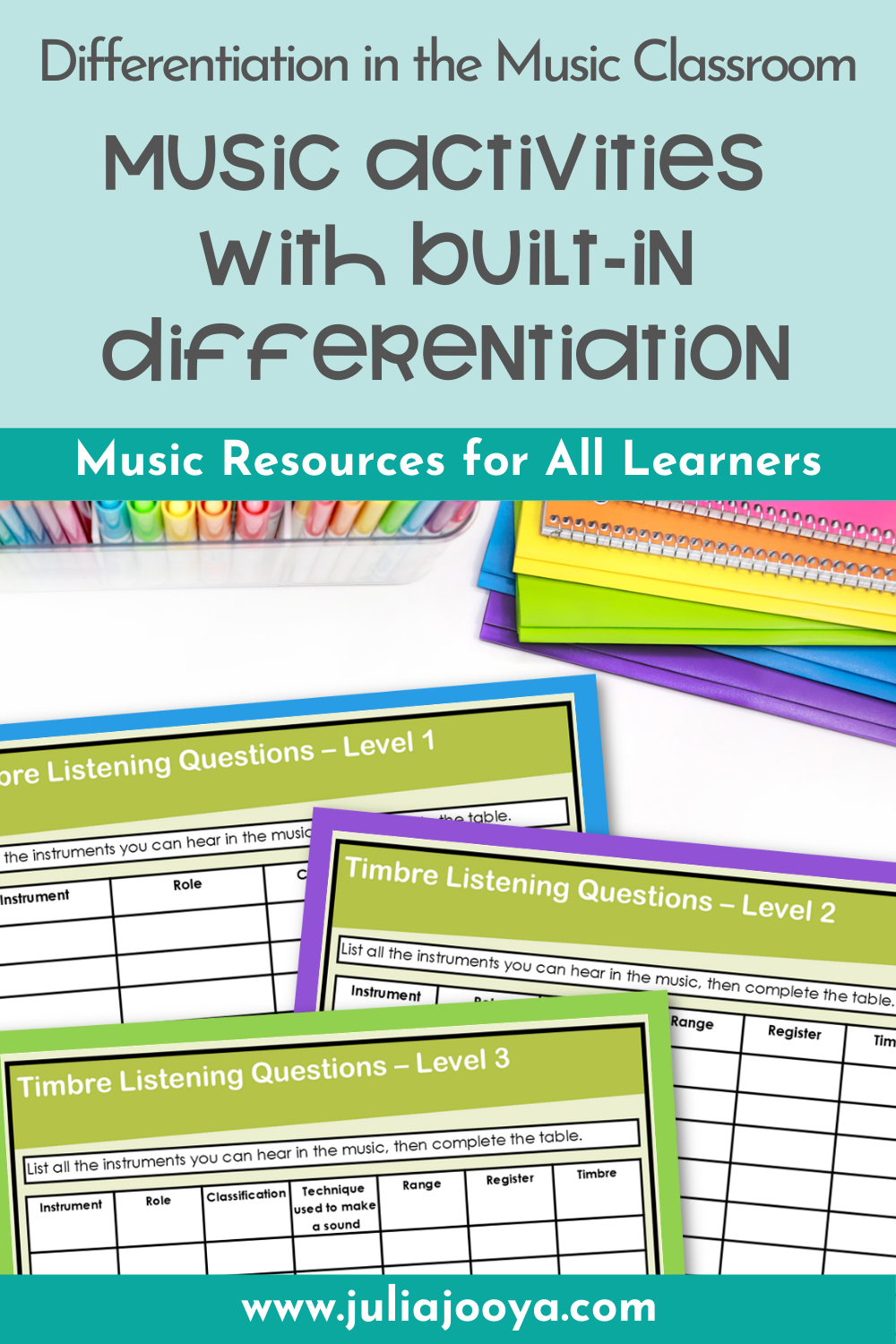
- printable and digital versions of the same music activities
- clear, high-contrast layouts with clean fonts
- resources that can be easily enlarged for students with low vision
- tasks that allow students to respond in different formats
For example, in one Grade 9 elective class I taught, I had:
- two students with very low vision
- a student supported through inclusive education
- students working significantly below expected literacy levels
- and highly capable students, including a pianist working towards advanced external exams
All students studied the same musical content, but accessed it through different music activities.
Using Music Activities That Support Different Ability Levels
One of the simplest differentiation strategies is adjusting how much support is built into the task — not the musical concept itself.
In my music terminology lessons, this meant:
- some students completed missing terms
- others completed full definitions
- advanced students refined and expanded explanations
The content stayed the same.
The expectations were adjusted.
This allowed lessons to keep moving, while still giving every student the opportunity to experience success.

Differentiation Through Listening Activities
Listening tasks are another area where built-in differentiation makes a huge difference.
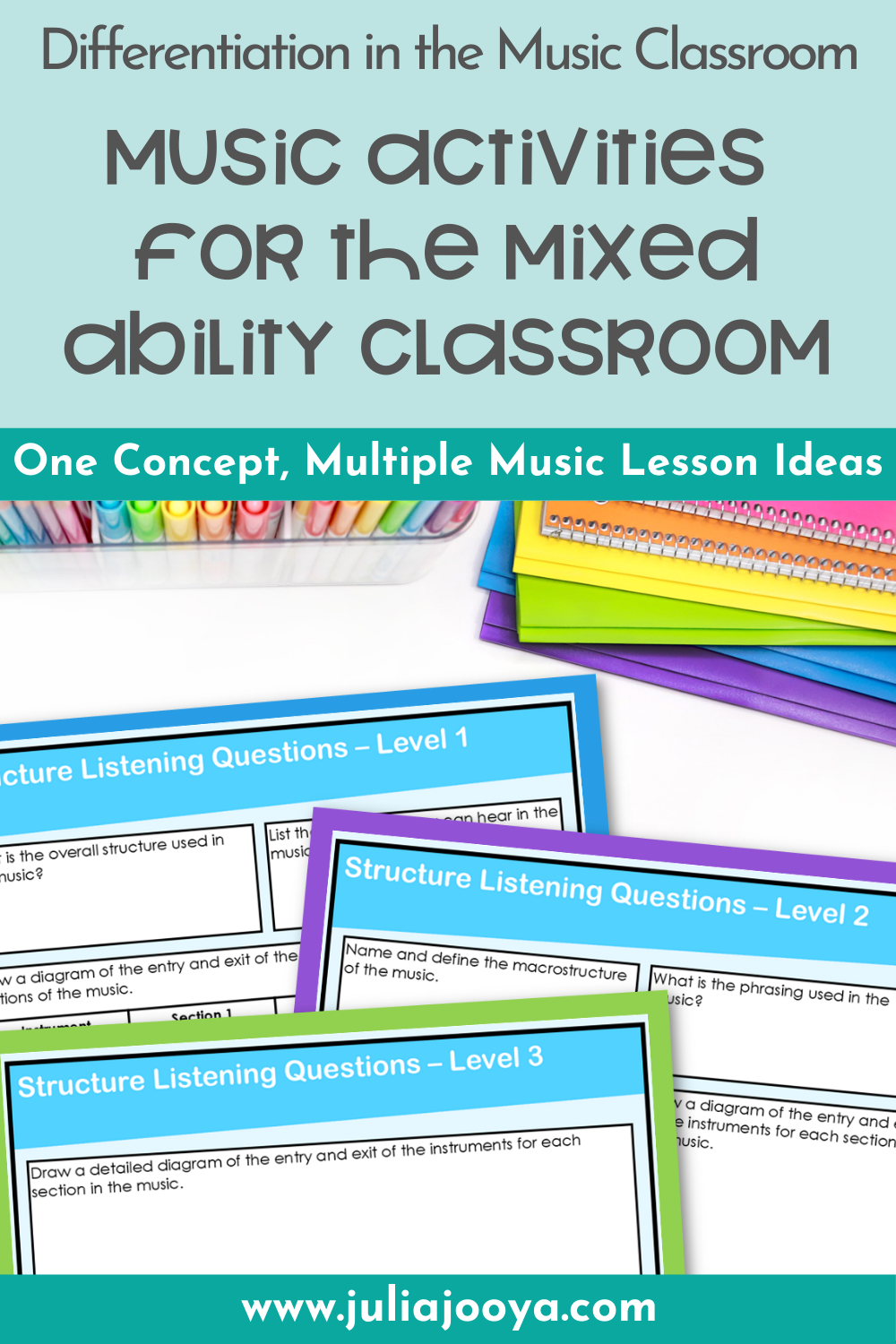
Within the bundle, students can use three levels of listening question cards. In practice, this means:
- all students respond to the same musical excerpts
- students choose a level that matches their confidence
- assessment remains fair and focused
In one listening test, students with learning difficulties outperformed some selective students — not because the test was easier, but because the music activities allowed them to show what they actually understood.
That’s powerful.
For more 6 Elements of Music teaching ideas use the link below to read the blog post.
Blog Post Link here for – How to Teach How to Analyse Music in a Way That Actually Sticks
Why Classroom-Ready Music Activities Matter
The biggest shift happens when teachers stop asking:
“How do I differentiate this?”
and start asking:
“Which music activity best supports this group?”
When differentiation and extension are already included:
- planning time is reduced
- lessons run more smoothly
- students feel capable, not exposed
- teachers feel confident, not stretched
This is especially important in elective music classes, where ability levels can vary widely.
This is exactly the kind of situation where built-in scaffolds make differentiation easier.
I’ve created a free Stage 4 Listening Sentence Starters and Writing Pack that you can use straight away to support different ability levels in the same lesson — without extra prep.
You can download it here and use it with any listening activity.
Link to the Free 6 Elements of Music Listening Sentence Starters here

Supporting Diverse Learners Without Overwhelm
Here’s the key takeaway:
Differentiation and extension do not need to be difficult.
When music activities are designed by a teacher who understands real classrooms — including low literacy levels, diverse learning needs, and limited planning time — the hard work has already been done.
The 6 Elements of Music Lessons & Worksheets Bundle was created to support exactly this reality. Every resource is classroom-tested, adaptable, and designed to meet students where they are — without requiring teachers to reinvent lessons.
Get the 6 Elements of Music Bundle here
If differentiation currently feels overwhelming, start small.
- Look at one upcoming lesson
- Choose one music activity that already includes flexibility
- Adjust delivery, not content
- Observe which students respond with confidence
You don’t need more resources — you need the right ones.
And when resources are built with differentiation in mind, supporting diverse learners becomes part of your normal teaching practice — not an extra burden.
Until next time
Happy Teaching
Julia from Jooya