

Writing about music is one of the most common challenges music teachers face when trying to get their students to express musical ideas clearly.
Students can hear what is happening in a piece, but when it comes time to explain it in writing, responses often become vague, repetitive, or avoidant altogether.
This is especially noticeable in assessment tasks, listening exams, and extended responses, where students are expected to critically analyse musical elements using accurate music terminology with a clear written structure.
Over time, I’ve learned that writing about music doesn’t improve through more practice alone. It improves when students are explicitly taught how to write about music, using a clear, repeatable process that removes the guesswork.
This post outlines a simple five-step teaching flow for writing about music that I use across all of my Stage 4, Stage 5, and Stage 6 classes.
Before we get into the five steps, would you like to see the scaffold I use with my own classes?
You can download a free sample from my M.U.S.I.C. writing framework — the Stage 4 Listening Sentence Starters and Writing Pack — and try it straight away with your students. It gives them a clear structure for turning what they hear into confident written responses.
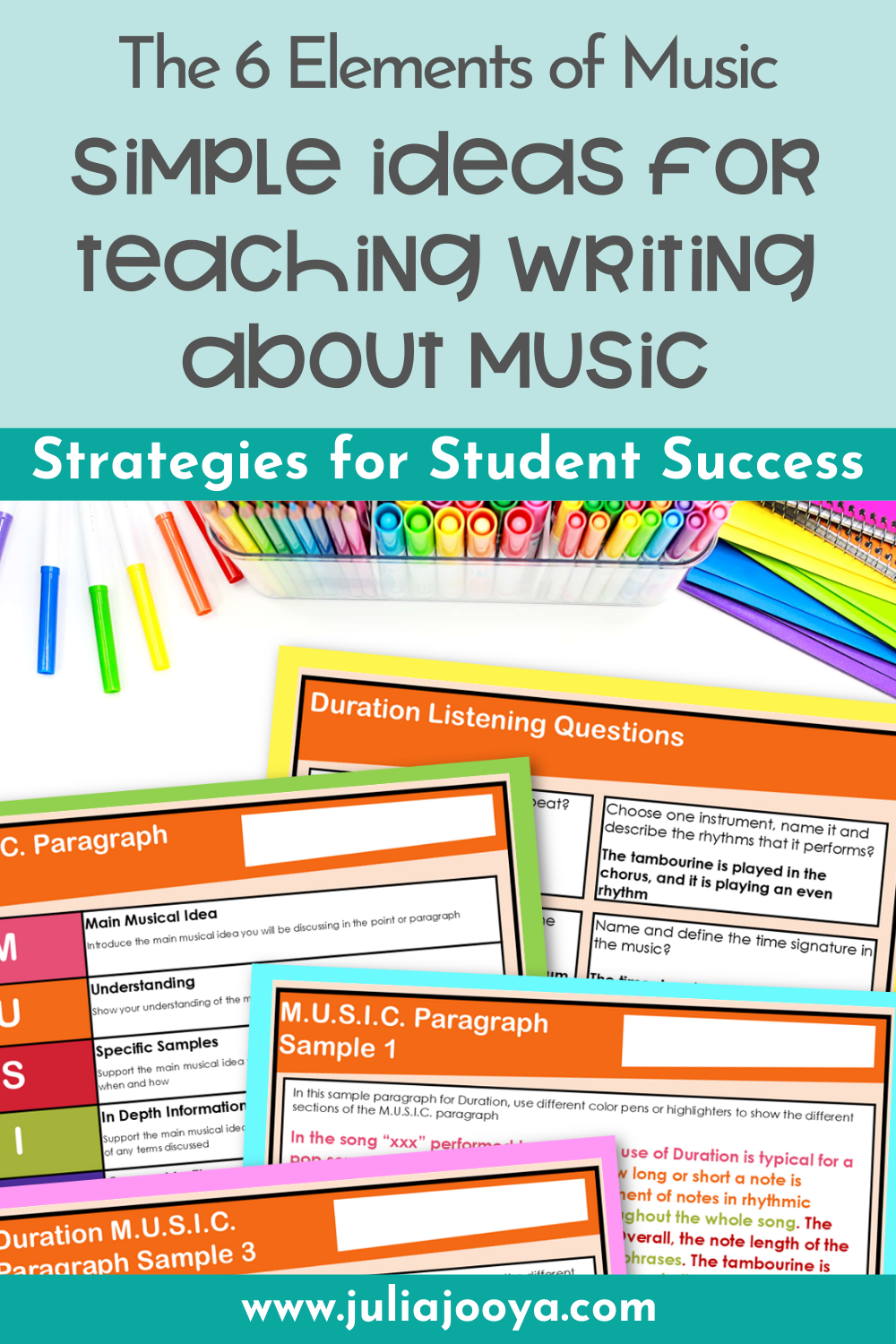
Why Writing About Music Needs a Clear Teaching Flow
Writing about music is a skill — not something students naturally know how to do.
Without a clear and easy to follow process, students often:
- hear musical ideas but can’t explain them
- include too much irrelevant information without a musical focus
- avoid written responses altogether
- lack confidence in assessment situations
But when students are explicitly taught to write about music they can:
- understand what is expected in a response
- organise their ideas more clearly
- use music terminology accurately
- build confidence over time
A clear teaching flow makes writing about music feel achievable — for students and teachers.

How This Music Paragraph Writing Scaffold Was Developed
This teaching strategy came about while I was supporting a Grade 12 music student preparing for three Musicology Viva Voces for her HSC exam.
She was excellent at analysing music on paper, but she struggled to organise her ideas into a clear, focused explanation during discussion. We tried several strategies, but nothing was quite working.
At the same time, I had already been using acronyms to support learning in other areas of music, and I knew that what she needed — and what many music students need — was a simple, repeatable scaffold for writing about music.
The idea for the M.U.S.I.C. paragraph structure came to me during one of my long drives to work. Those quiet moments are often when I do my best thinking — processing student needs and refining teaching approaches that make learning clearer.
Once I introduced this scaffold, everything changed — not just for that student, but for many others.

Step 1: Model Writing About Music Explicitly
The first step in teaching the paragraph writing structure is modelling.
Before asking students to write independently, they need to see:
- what a strong written paragraph looks like
- how musical ideas are organised
- how music terminology is used in context with a real piece of music
At this stage, the teacher:
- chooses a short piece of music
- focuses on one element of music
- talks through the thinking and writing process aloud
- demonstrates how ideas are shaped into writing
This process removes ambiguity and gives students a clear starting point.
If you would like more ideas for how to help your students analyse music, read this blog post – How to Teach How to Analyse Music in a Way That Actually Sticks
Click here to read the blog post
Step 2: Teach the M.U.S.I.C. Structure for Writing About Music
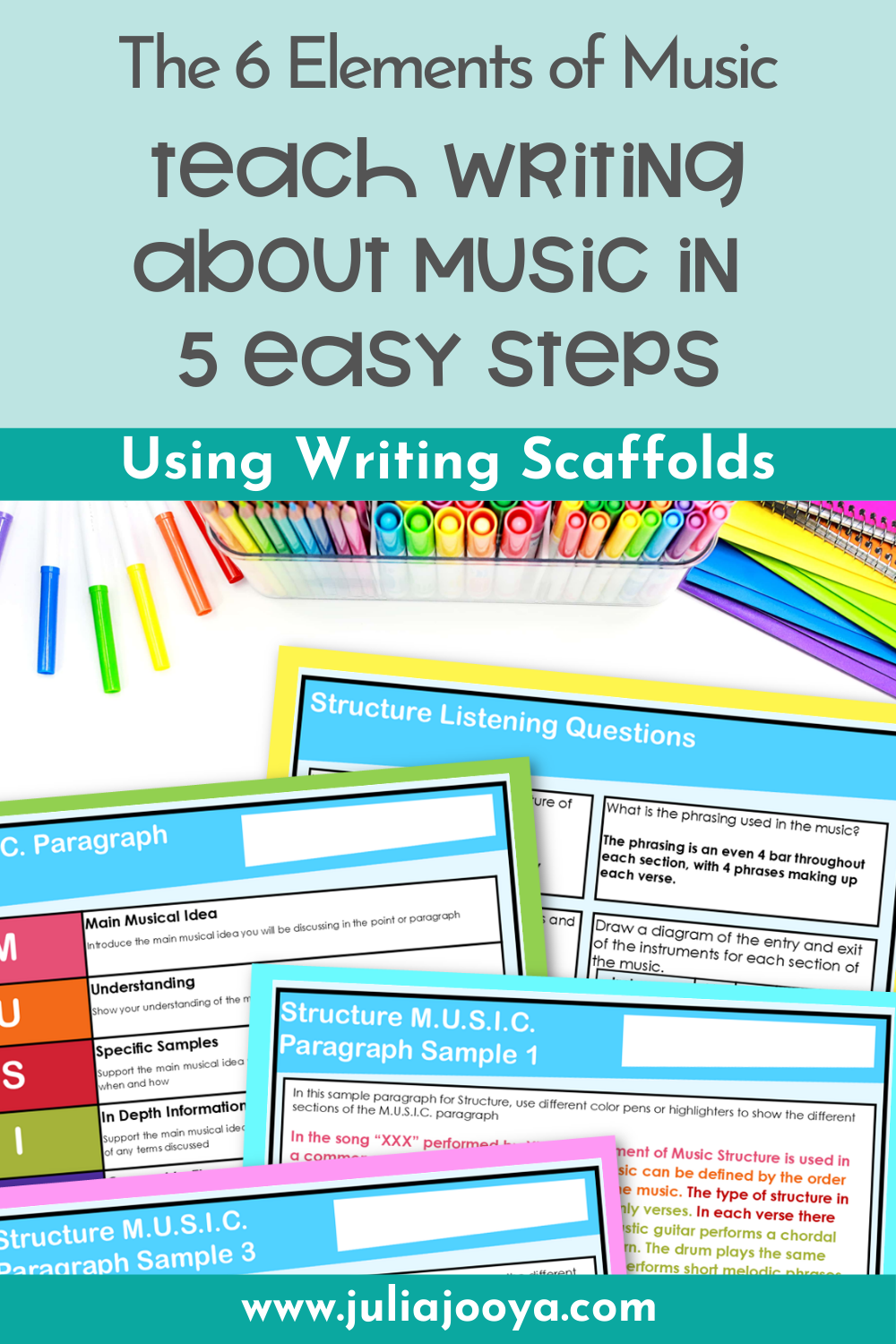
Once students understand the purpose of the writing and responding to music task, they are introduced to the M.U.S.I.C. paragraph scaffold, which provides a consistent structure for writing about music.
Each paragraph includes:
- M – Main musical idea
- U – Understanding of the idea
- S – Specific musical examples
- I – In-depth explanation of those examples
- C – Connection back to the main idea
This structure helps students stay focused and prevents responses from becoming a list of disconnected observations.
When teaching this step, it’s important to:
- explain each part clearly
- show multiple examples
- discuss why each section matters
Using this scaffold and process for writing becomes far less intimidating when students know exactly what they are aiming for.
Step 3: Write About Music Together as a Class
The next step is guided practice.
As a class, students:
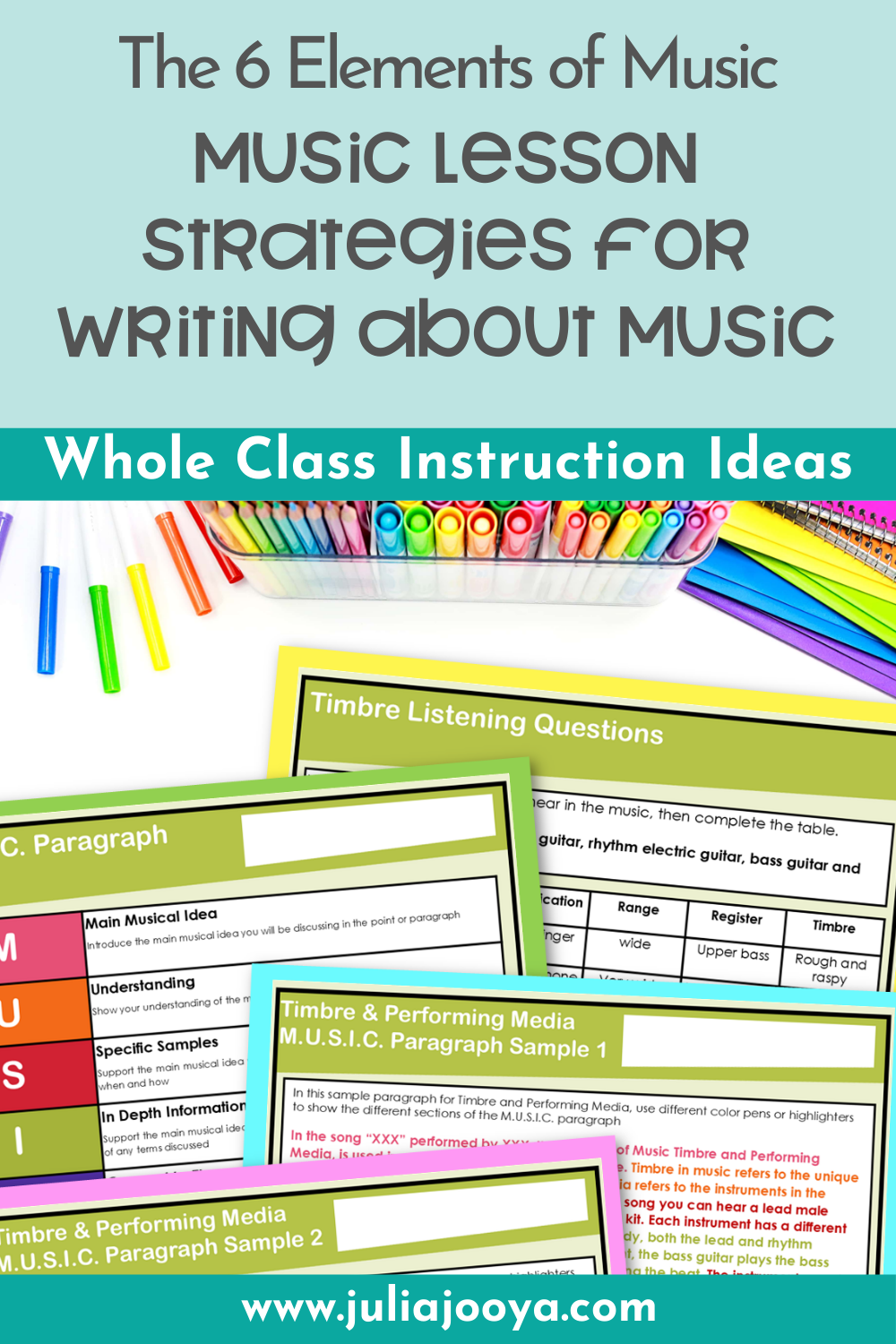
- answer listening questions together
- identify relevant music terminology, and define it as they go
- build a paragraph collaboratively
I often use different coloured markers to show each part of the M.U.S.I.C. structure, which helps students visually see how writing about music is organised.
At this stage, the focus is not on perfect musical understanding — it’s on learning the process of writing about music successfully.

Step 4: Support Independent Writing About Music
Once students are comfortable with the structure, they move into independent writing.
Students:
- choose or are given a piece of music
- focus on one musical element
- write their own M.U.S.I.C. paragraph
- swap and compare responses with peers
Using coloured highlighters to identify each part of the paragraph is particularly effective. It allows students to self-check and reflect on their written response.
Feedback becomes much easier because it is clear which part of the structure might be missing or needs improvement.
Curious to see how the M.U.S.I.C. scaffold works in action?

Step 5: Repeat the Writing About Music Process Over Time
The final step is repetition — not in a boring way, but through consistent application.
Written responses improves when students:
- revisit the same structure regularly
- apply it to all 6 elements of music – duration, dynamics and expression, pitch, structure, texture and timbre
- Use and apply it across listening, performing, and composition tasks
I use this teaching and learning cycle from Year 7 through to Year 12. It works because students know what is expected, and expectations stay consistent. What changes at between stages is the depth of musical understanding for each of the 6 elements of music.
That original Grade 12 student went on to be very successful in her HSC and later continued into further study. The same scaffold has since supported hundreds of students in developing confidence with writing about music.

Teaching Support for Writing About Music
Explicitly teaching writing about music doesn’t have to increase your workload.
The M.U.S.I.C. paragraph scaffolds, listening question cards, student samples, and marking rubrics are embedded within the 6 Elements of Music Lessons & Worksheets Bundle, aligned to the new NSW Music Syllabus.
These resources:
- support the modelled-guided-independent cycle with links to demonstration videos
- include student examples
- save planning time
- can be reused across multiple year groups and with any piece of music chosen for study and analysis
All the resources in the bundle have been carefully designed to make teaching writing about music clearer and more manageable.
Link here to the 6 Elements of Music Lessons & Worksheets Bundle for the New NSW Syllabus
You don’t need to change everything at once.
Try one step this week:
- model a paragraph
- introduce a clear structure
- write a response together
Small, consistent changes make writing about music less overwhelming and far more successful over time.
Until next time
Happy Teaching
Julia from Jooya