
Learning how to analyse music is one of the most challenging skills for most music students to master — and one of the most frustrating for teachers to teach.
Students can hear the music.
They can tell you whether they like it or not.
But when it comes time to explain how the music works, responses often become vague, surface-level, or completely off track.
If you’ve ever asked your music students to analyse a piece of music and received written responses and paragraphs that sound more like a biography than a musical response, you’re not alone. The good news is that this isn’t a motivation problem — it’s a teaching and structure problem. And it’s one that can be fixed.
This post focuses on how to analyse music using listening questions, and how to use them in a practical, realistic classroom setting so the learning actually sticks.

Why Students Struggle With Musical Analysis
One of the biggest reasons students struggle with musical analysis is simple:
they don’t know what to listen for.
When students are asked to “analyse the music,” many don’t understand what that actually means. Without guidance, they default to:
- describing the artist or band
- retelling background information
- using vague phrases like “it sounds happy” or “it gets louder”
This is especially common in Stage 4 and early Stage 5, but it doesn’t disappear on its own. If students aren’t explicitly taught how to analyse music, the same issues appear in senior classes — just with longer words and more filler.
Learning how to analyse music requires structure, repetition, and very clear expectations. That’s where listening questions become essential.
If you would like a simple FREE resource to help you and your students get started with how to analyse music, I created a free resource to make music writing easier for your students.
Get your Stage 4 Listening Sentence Starters and Writing Pack here.

Why Learning How to Analyse Music Matters
Listening and responding is a core part of the NSW Music syllabus across Stage 4 and Stage 5. Students are expected to:
- identify elements of music
- describe how those elements are used
- explain musical effects
- justify their ideas using correct terminology
These skills don’t just support listening tasks. They underpin:
- written assessments
- comparison questions
- performance reflections
- composition evaluations
If students don’t learn skills in musical analysis early and explicitly, they struggle in every area of the course. Teaching this skill well builds music literacy and gives students confidence across all practical and theoretical work.
How to Analyse Music Using Listening Questions
The most effective way I’ve found to teach how to analyse music is through structured listening questions that stay consistent across lessons.
Listening questions give students a clear focus. Instead of asking them to analyse everything, the questions narrow their attention to one element of music at a time. This makes the task manageable and achievable.
In my own classroom, listening questions are not a one-off worksheet. They are a teaching tool that gets reused again and again.
Each set of listening questions:
- targets one element of music
- uses clear, student-friendly language
- prompts students to listen for specific features
- encourages the use of correct music terms
This structure helps students understand how to analyse music rather than guessing what the teacher wants.
How to Analyse Music Step by Step in the Classroom
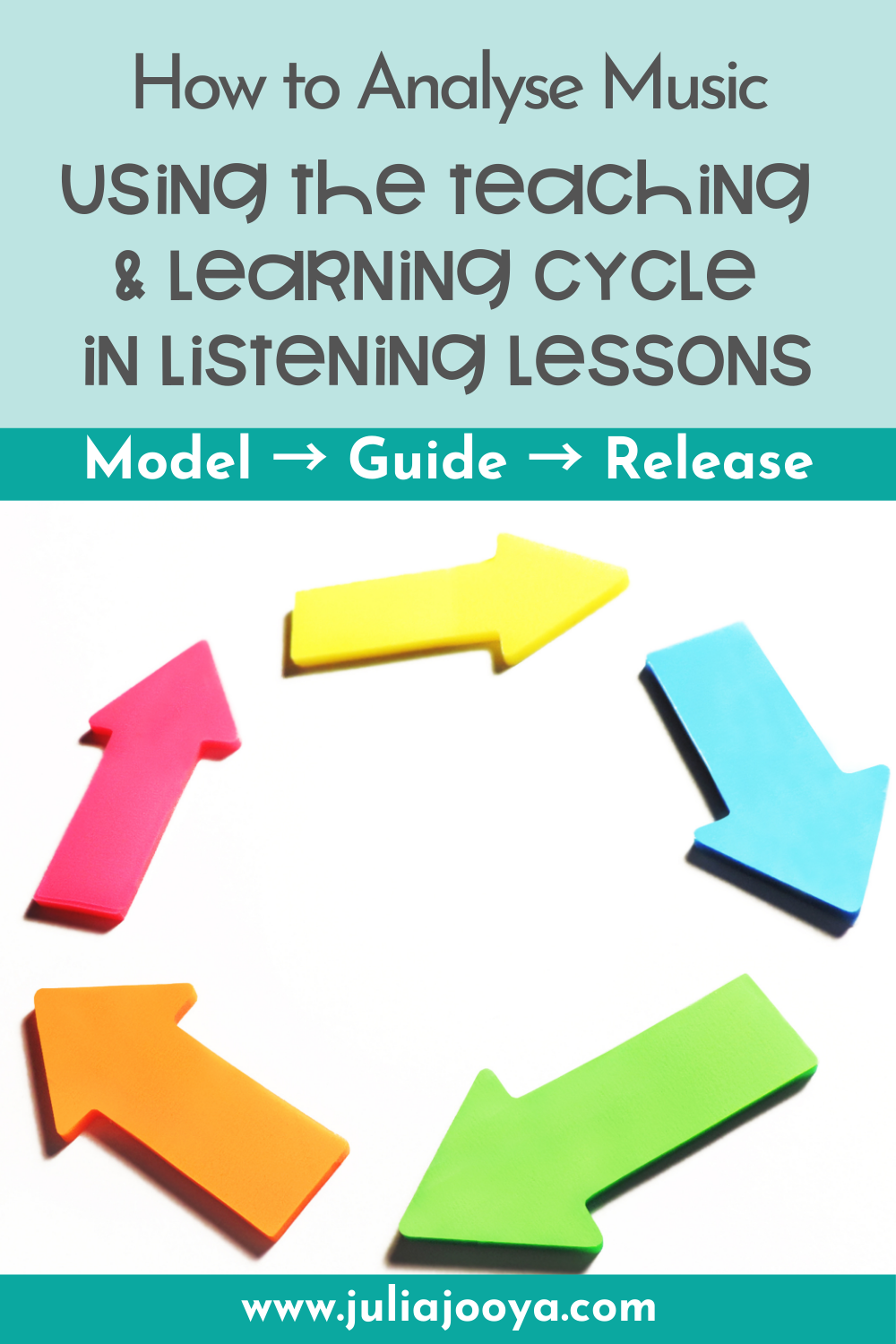
Teaching how to analyse music works best when it follows a modelled–guided–independent teaching cycle.
Step 1: Model How to Analyse Music
Start with a whole-class listening task.
Choose a short musical excerpt and walk students through the listening questions.
At this stage, you:
- read the question aloud
- unpack what the question is asking
- highlight the music terms students should listen for
- model an example response
Students are watching how to analyse music in action. This step is essential and often skipped due to time pressure.
Step 2: Guided Practice With Listening Questions
Next, play another example and have students respond with support.
This might include:
- pausing the music
- prompting students with follow-up questions
- reminding them to use specific music terms
- allowing pair or small group discussion
This guided stage is where misconceptions are addressed and confidence grows.
Step 3: Independent Listening and Analysis
Finally, students respond independently using the same listening questions.
Because the structure is familiar, students can focus on the music itself rather than figuring out what to write. This is where you start to see clearer, more detailed responses.
This cycle should happen repeatedly over several lessons and across each element of music.

How to Analyse Music Using Consistent Language
One of the biggest breakthroughs in teaching how to analyse music is consistency.
Students struggle when:
- questions change wording every lesson
- expectations shift between tasks
- music terms are introduced randomly
Using consistent listening questions and terminology removes unnecessary cognitive load. Students begin to internalise the language of analysis.
In the NSW Elements of Music Bundle, each element includes:
- a mind map of key music terms
- a word bank students can refer to
- scaffolded listening questions
- sample paragraph responses
Because the language stays the same, students don’t have to relearn how to analyse music every time the context changes.
And if you would like more information on the importance of teaching music terms, read the blog posts linked below.
Blog Post link here – Why Music Terms are Important for your Students to Understand

How to Analyse Music Using Scaffolded Listening Questions
Not all students need the same level of support — and that’s where scaffolded listening questions are powerful.
In my classroom, listening questions are differentiated across three levels:
- Level 1: Stage 4 and lower-ability Stage 5
- Level 2: On-grade Stage 5
- Level 3: Advanced Stage 5 and elective classes
All students are analysing the same music, but the depth of questioning changes. This keeps expectations high while still supporting access.
Comparison listening questions are also being added to support students moving toward Stage 6-style thinking, especially for Year 10 elective classes.
I’ve turned this strategy into a printable worksheet pack you can use in class.
Get your free Stage 4 Listening Sentence Starters and Writing Pack here.

How to Analyse Music Without Overwhelming Students
One common concern teachers have is that teaching how to analyse music will take too long.
In reality, the opposite is true.
Once students know how to analyse music:
- lessons run more smoothly
- fewer explanations are needed
- assessment prep becomes easier
- marking is faster and more meaningful
Listening questions become a lifelong classroom tool. My original sets lasted over ten years — they were only updated because the syllabus changed.
Using ready-made, classroom-tested resources saves planning time and reduces teacher workload while improving student outcomes.

Teaching Support That Makes How to Analyse Music Easier
Teaching how to analyse music is far more manageable when the resources are already structured.
The 6 Elements of Music Lessons & Worksheets Bundle for the New NSW Syllabus includes:
- listening question cards for each element
- printable and digital formats
- consistent terminology across lessons
- resources tested with Stage 4 and Stage 5 students
- ongoing updates as the syllabus evolves
It’s not a textbook. You don’t need multiple copies. You purchase once and use it year after year.

Your Next Step
If your students struggle to explain what they hear, the issue may not be effort — it may be structure.
Teaching how to analyse music works best when students:
- know what to listen for
- have clear listening questions
- are exposed to consistent language
- practise repeatedly over time
You don’t need to change everything at once. Start with one element of music, one set of listening questions, and one clear teaching cycle.
Get the NSW Elements of Music Bundle here
Until next time
Happy Teaching
Julia from Jooya
4 Responses