

Have you ever been frustrated by the lack of musical terminology your students use?
Or have you ever asked your students to describe what they heard in a piece of music… and all you got back was, “It sounds nice” or “It’s loud”, or even worse “the drums play the melody”?
You’re not alone. Music teachers everywhere know the frustration of vague answers. Students can hear the music, but they don’t always have the words to explain it. That’s where musical terminology and definitions come in.
When you give students the vocabulary they need, you’re not just teaching them “fancy music words.” You’re building their music literacy—their ability to read, write, and talk about music with accuracy and confidence.
What Do We Mean by Music Literacy?
Music literacy is more than reading notation or sheet music. It’s the skill of being able to describe what you hear and perform using the correct musical language.
Think of the difference:
- “The drums were loud” → vague
- “The percussion created accented beats with strong dynamics” → music literacy
That one simple shift sets students up for stronger listening responses, better written analysis, and more meaningful discussions about music.
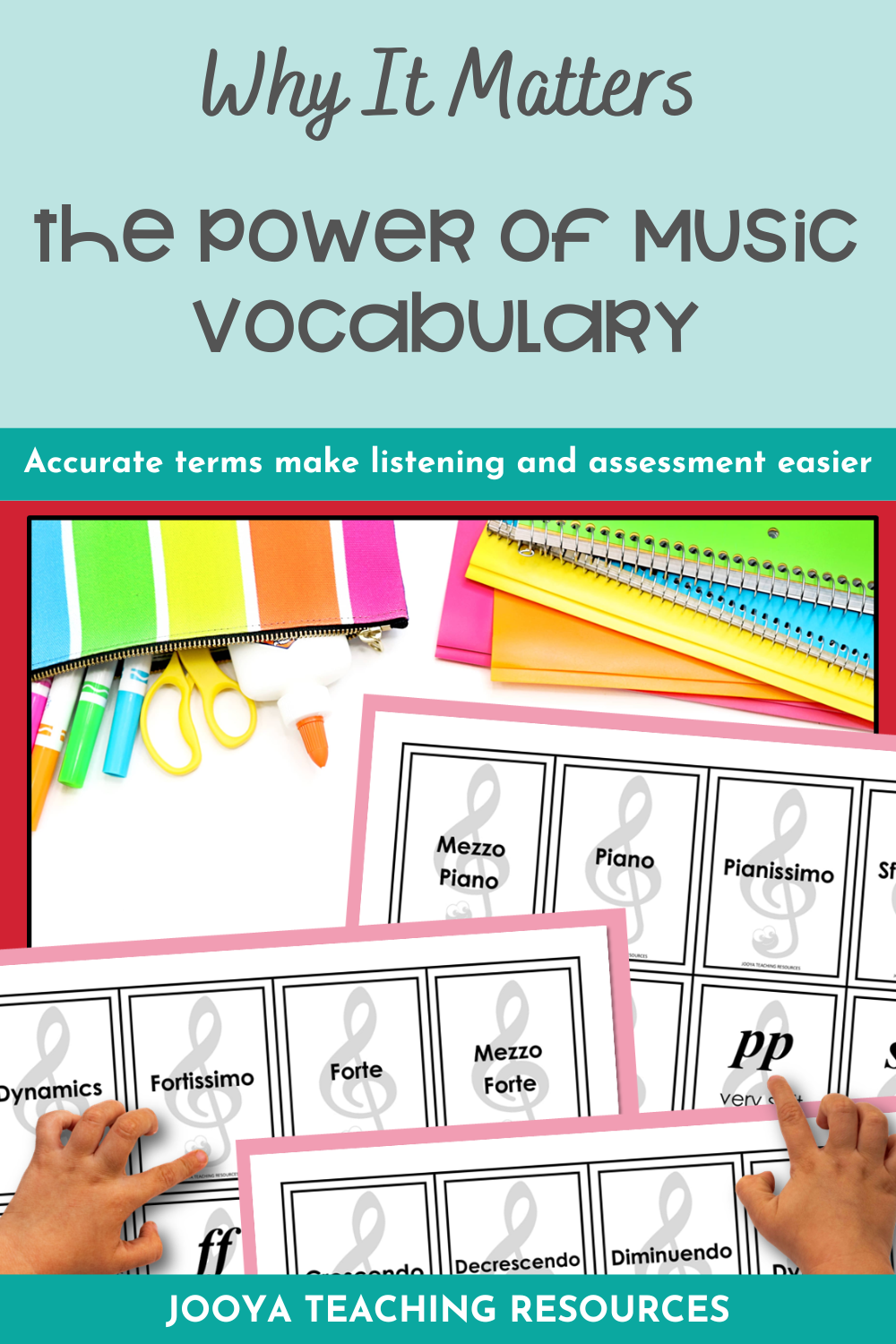
Why Musical Terminology and Music Definitions Matter
Your music students need a shared language to talk about pitch, duration, dynamics, timbre, texture, and structure (the six elements of music in the NSW syllabus).
Without a clear musical vocabulary, they end up with surface-level comments. But with a strong musical terminology foundation, they:
- Write stronger aural exam responses
- Explain their performance choices
- Build confidence when discussing music in class
And here’s the best part: once they know the words, they actually start listening more deeply because they have the tools to describe what they’re hearing.
One teacher recently told me that before using these resources, she often stayed up late the night before lessons pulling something together. Once she had the bundle ready to go, she said it felt like “breathing room.” That’s the power of having clear, flexible, and reliable tools for teaching music vocabulary.
Simple Strategies for Teaching Musical Terminology and Definitions
It’s one thing to know what you want your students to be able to do, but actually getting them there? That’s where it can be hard!
As a young music teacher, early in my career, I would get frustrated when my students couldn’t give me the responses I wanted. I was in the staffroom complaining about how my students were failing with their responses to the music we were listening to in class. A colleague said something that blew me away with its simplicity! They simply asked me – when did you teach them how to respond to the music?
They were right!
When did I teach them?
When did I actually give them the musical terminology to use in their responses?
I hadn’t.
That’s when I changed how and what I taught from that moment on and I have never looked back.
Below are a few simple and effective ideas to help you start teaching musical terminology to your students.
1. Start Small with Verbs and Adjectives
Instead of overwhelming your students with a full collection of a music glossary on day one, start with a handful of verbs describing music (driving, flowing, pulsing) or adjectives in music (bright, mellow, heavy).
Put them on a word wall, make them part of exit tickets, or have students keep a running list in their notebooks. Work together to come up with words to describe the music that you have chosen to study.
Once you have a list of music words and adjectives, model to your students how to use them to describe the music in a more musical way.
-
Make It Active with Games
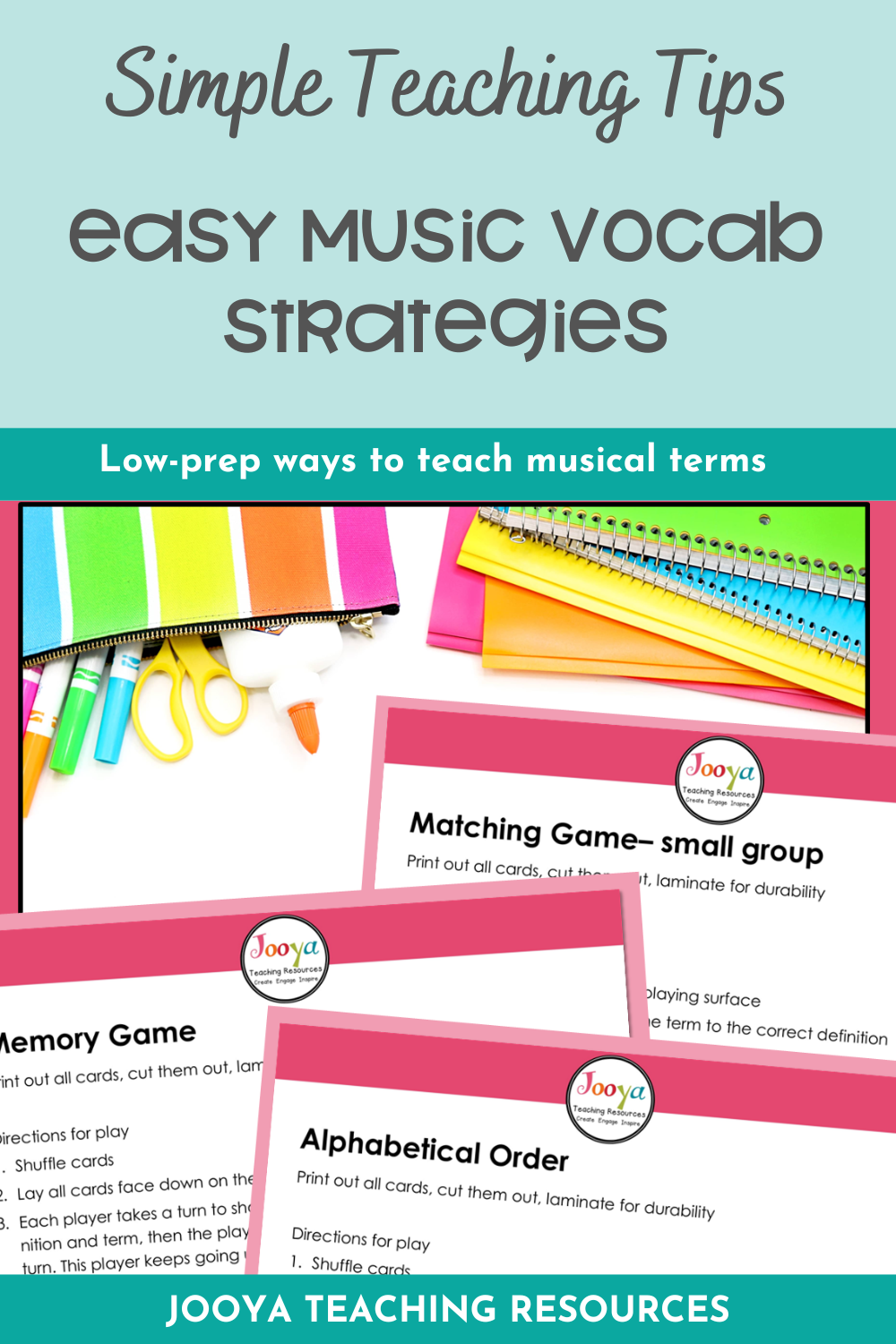
Musical Terminology doesn’t have to mean worksheets and memorisation. Try these classroom-tested games with your musical term cards:
Memory
- Shuffle and lay all cards face down.
- Students take turns flipping two cards at a time.
- If the term and definition match, the student keeps the pair and takes another turn.
- The game continues until all matches are found.
- The player with the most pairs wins.
Alphabetical Order
- Shuffle the music term cards and give a set to each small group.
- Students match terms to their definitions.
- Once matched, they place the terms in alphabetical order.
- The first group to complete the task correctly wins.
- Try some variations where the students have to complete the sorting in silence!
Match It (Small Group Version)
- Shuffle cards and lay them face up.
- Students work together to pair each term with its correct definition.
- Option: turn it into a race between groups to see who can match them first.
Match It (Whole Class Version)
- Hand out one card per student (terms and definitions).
- Play music while students walk around swapping cards.
- Stop the music — each student has to find the partner card that matches theirs.
- Repeat until everyone has rotated through several cards.
These games work brilliantly as whole-class activities, quick time-fillers, or sub plans.
-
Try Kagan Cooperative Strategies
Want to add even more variety? The cards work perfectly with Kagan Cooperative Strategies.
A few ideas to try:
- Quiz-Quiz-Trade: Students walk around with a card, quiz each other on the definition, then swap and move on.
- RallyCoach: In pairs, one student answers by matching the term and definition while the other coaches.
- RoundRobin: In small groups, students take turns giving examples of each term in context.
These approaches turn simple card activities into highly interactive, student-centred learning experiences.
If you want to know more about Kagan Cooperative Strategies, please visit their website here
-
Scaffold for Different Levels
- For younger or beginner students → use fewer terms, focus on the most common ones for each element of music that you want them to learn and use.
- For older students → expand into specific musician terms like pizzicato, vibrato, or syncopation.
- For mixed-ability groups → assign differentiated word sets so everyone works at the right level.
-
Reinforce in Writing Tasks
After your students have had a chance to learn some musical terminology, they need to have opportunities to use their new found music vocabulary. Challenge your music students to include at least 3–5 music terms in every paragraph response.
Give them sentence starters like:
- “The composer used ___ to create ___.”
- “The ___ section features ___ to highlight ___.”
- “The overall structure of the music is __________ because______.”
- “The instruments that I can hear in the first section include__________.”
- The type of texture used in the music is __________ and this means ________.”
Over time, this practice shifts them from one-word answers to full, confident musical explanations.

3 Ways to Use Musical Terminology Cards with Elements of Music Mind Maps
One of the best things about the Elements of Music Term Cards is how easily, and beautifully they pair with the free Elements of Music Mind Maps. When you use the two together, students don’t just memorise definitions — they actively apply the vocabulary to real listening, performing, and composing tasks.
Grab your own set of the Free Elements of Music Mind Maps here
Here are three simple (but powerful) ways to use them:
1. Listening Maps
- How it works: Give students a blank mind map and a selection of term cards before listening to a piece of music.
- As the music plays, they choose relevant terms from the cards and place them on the correct branch of the mind map.
- Once the listening is over, the mind map becomes their reference point for writing a stronger response.
Tip: Start with just a few cards for beginners, and gradually add more as their confidence grows.
-
Performance Reflection
- How it works: While watching a live or recorded performance, students use the mind maps and term cards to track what they hear and see.
- They might note dynamics changes, timbre differences, or structural features on their map.
- Afterward, extend the activity into an evaluation task:
- Written reflection (“The performer used ___ to create ___.”)
- Or small-group discussion where students share terms and examples they identified.
Tip: This works really well with peer performances or YouTube concert clips.
-
Composition Planning
- How it works: Before starting a composition project, give students a mind map as a planning tool.
- Have them select term cards that represent the choices they want to make for each element (e.g., “ostinato” for duration, “legato” for melody, “crescendo” for dynamics).
- This helps students plan their piece with clear musical intent and ensures their vocabulary develops alongside their creative work.
Tip: Collect the maps at the end — they make excellent process evidence for assessment.
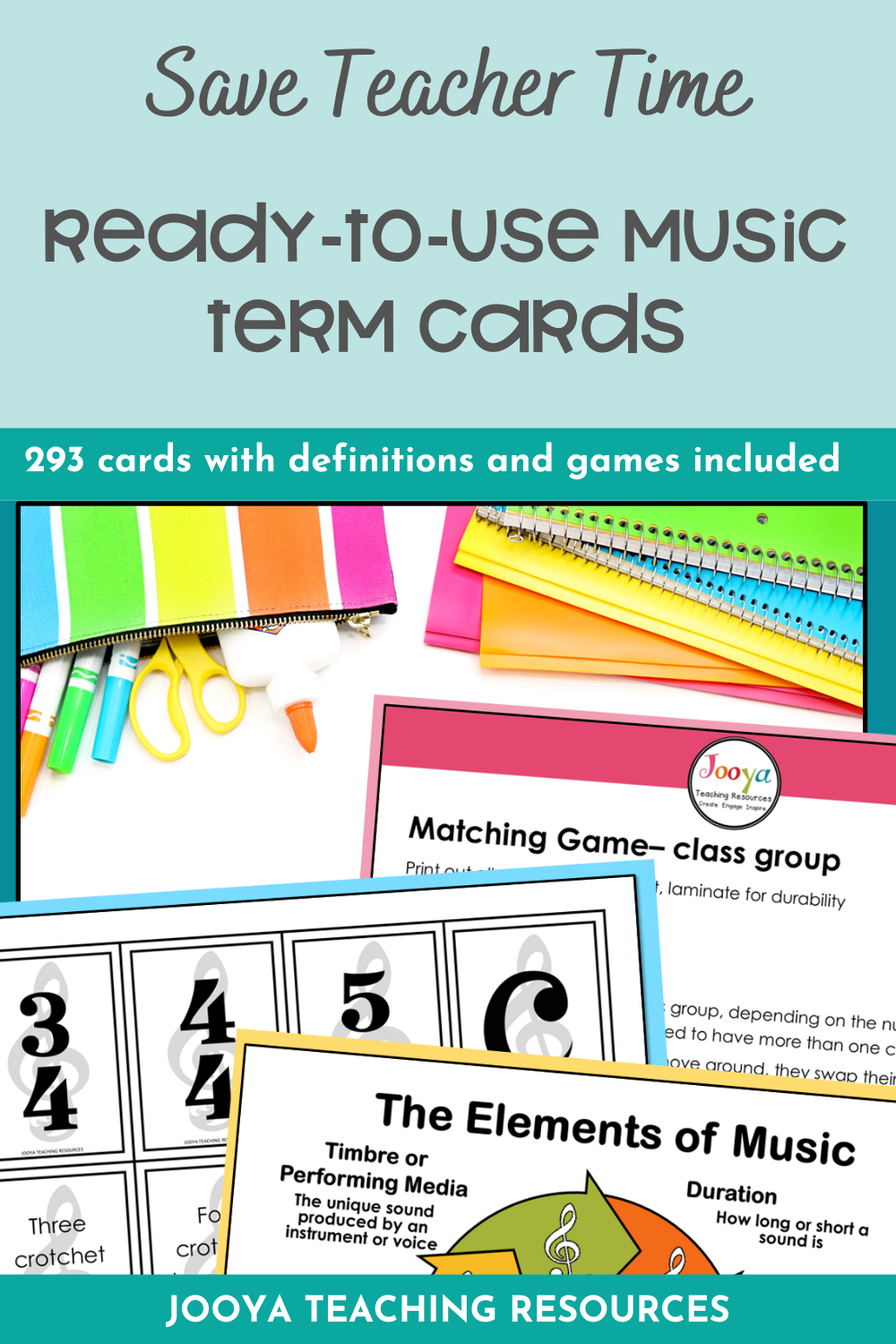
The Easy Way: Ready-to-Use Musical Terminology Cards
If you’re tired of making your own music vocabulary lists or you find yourself running out of fresh activity ideas, I’ve already done the hard work for you.
The NSW Elements of Music Term Cards Bundle includes 293 musical terms and definitions with ready-to-use games and classroom activities.
You’ll get:
- Print-and-go cards aligned to the NSW syllabus
- 4 classroom-tested games (Memory, Match It, Class Match, Alphabetical Order)
- Easy differentiation by element, age group, or activity type
A flexible resource you can use year after year
And if you’re not in NSW, don’t worry. The 6 Elements of Music Term Cards Bundle works just as well in general music or middle school classrooms anywhere.
Link to the NSW 6 Elements of Music Term Cards Bundle here
Or if you prefer, here’s the link to my original set for the 8 Elements of Music.
The Long-Term Payoff for Learning Musical Terminology
When you consistently use musical vocabulary and definitions in your classroom, your students start using them too—naturally and confidently.
Instead of hearing, “It’s loud,” you’ll start hearing:
- “The brass section created accented stabs with strong dynamics.”
- “The strings played a flowing, legato melodic line.”
- “The layers of sound started very thin in the first section, and slowly as instruments entered the music, the textural density became thicker and thicker.
That’s music literacy in action!
And if you are looking for more teaching ideas for the new NSW Music Syllabus, read this blog post!
Ready to Boost Music Literacy in Your Classroom?
You don’t have to piece together vocab lists or spend hours reinventing the wheel. With the NSW Musical Term Cards Bundle [link here] (or the 8 Elements Bundle [link here] if you’re outside NSW), you’ll have everything you need to build strong, confident music writers and thinkers.
Your students will thank you, and you’ll finally get the answers you’ve been waiting to hear.
Until next time,
Happy Teaching,
Julia from Jooya