
The new NSW Music Syllabus for Stages 4 and 5 has undergone significant updates, streamlining learning outcomes, refining assessment practices, and placing a greater emphasis on the 6 Elements of Music. These changes align with the NSW Education Standards Authority (NESA) guidelines and the Australian Curriculum, ensuring that music teachers in NSW can deliver a more structured and engaging music education experience for their high school students.
If you’re a classroom NSW music teacher navigating these proposed changes, this post will break down key updates, explain the focus areas of the new music syllabus, and provide 7 teaching resources to help you implement these changes efficiently. Plus, we’ll highlight an Elements of Music Resource Bundle, that has been carefully designed and created to save you time and stress when teaching the new NSW Music Stage 4 and 5 syllabuses.

Understanding the New NSW Music Syllabus
The revised NSW Music Syllabus now better aligns with the Australian Curriculum, integrating key content statements and music assessment strategies designed to support young people in NSW schools. Some of the most significant updates include:
- A Focus on the 6 Elements of Music: The concepts of music have been refined into six essential elements—Duration, Dynamics and Expression, Pitch, Structure, Texture, and Timbre & Performing Media—which underpin all music learning activities.
- Greater Emphasis on Cultural Expression: The syllabus acknowledges Aboriginal education, Torres Strait Islander learner perspectives, and the role of ongoing custodians of the lands and traditional owners in music education.
- Updated Learning Outcomes & Assessment Practices: The number of syllabus outcomes has been reduced, making the study of music more teacher-friendly and easier to assess. Summative assessment models and depth study options also provide greater flexibility.
- Integration of Digital Technologies: The syllabus encourages the use of digital technologies to enhance music education, facilitating outside school hours learning and online experiences.
These changes create a more student-centered approach, ensuring that music students develop essential musical skills and engage in meaningful learning experiences.

What are the 6 Elements of Music in the NSW Music Syllabus?
The new NSW Music Syllabus structures musical knowledge around six core elements of music, shaping how students analyse musical ideas and repertoire. Here’s a detailed breakdown of each element:
- Duration – The length of sounds and silences in music. This includes aspects such as beat, rhythm, tempo, and time signatures, forming the foundation of musical structure.
- Dynamics & Expression – The volume of sound and the way it is performed. This covers dynamic levels (such as forte and piano), articulation (such as staccato and legato), and expressive techniques that shape musical interpretation.
- Pitch – The relative highness and lowness of sounds. This encompasses melody, harmony, tonality, and intonation, allowing students to explore how pitch is organized in different musical styles.
- Structure – The design or form of a piece of music. It refers to how musical sections are arranged and repeated, including forms such as binary, ternary, rondo, and sonata form.
- Texture – The way layers of sound interact in a piece of music. It includes monophonic, homophonic, and polyphonic textures, giving insight into how different musical lines function together.
- Timbre & Performing Media – The unique quality of a sound that allows instruments and voices to be identified. This includes tone color and the various sound sources used in musical performance.
These key features help students develop verbal knowledge and critical listening skills while engaging with diverse repertoire requirements.

15 Teaching Ideas for Performing, Composing, and Listening
To support teachers in implementing the new syllabus, here are five teaching ideas for each focus area: Performing, Composing, and Listening.
Performing
- Ensemble Performances – Assign students different roles in a group performance to enhance collaboration and ensemble awareness.
- Call and Response Activities – Develop students’ listening and timing skills through echo and improvisational exercises.
- Layered Rhythms – Have students perform rhythmic ostinatos to explore duration and texture.
- Dynamic Interpretation Exercises – Provide a simple melody and challenge students to experiment with dynamics and expression.
- Digital Performance Recording – Use recording software to allow students to critique and improve their performances.
Composing
- Graphic Score Composition – Students create and perform compositions using non-traditional notation.
- Melodic Transformation – Have students take an existing melody and manipulate pitch, rhythm, and dynamics.
- Storytelling Through Sound – Students compose a piece that conveys a narrative using only instrumental timbres.
- Theme and Variations – Teach students how to develop a melody through variation techniques.
- Film Scoring Project – Assign students a short video clip and have them compose music that enhances the visual elements.
Listening
- Comparative Listening Analysis – Play different versions of the same piece and discuss variations in structure and timbre.
- Listening Maps – Provide visual representations of music to help students track form and texture.
- Silent Score Reading – Have students analyze a score before hearing the piece, predicting musical elements.
- Call and Identify – Play short excerpts and ask students to identify the elements of music being demonstrated.
- Podcast Reflections – Students record their thoughts on a piece of music, discussing elements such as dynamics and structure.
The Benefits of the New NSW Music Syllabus
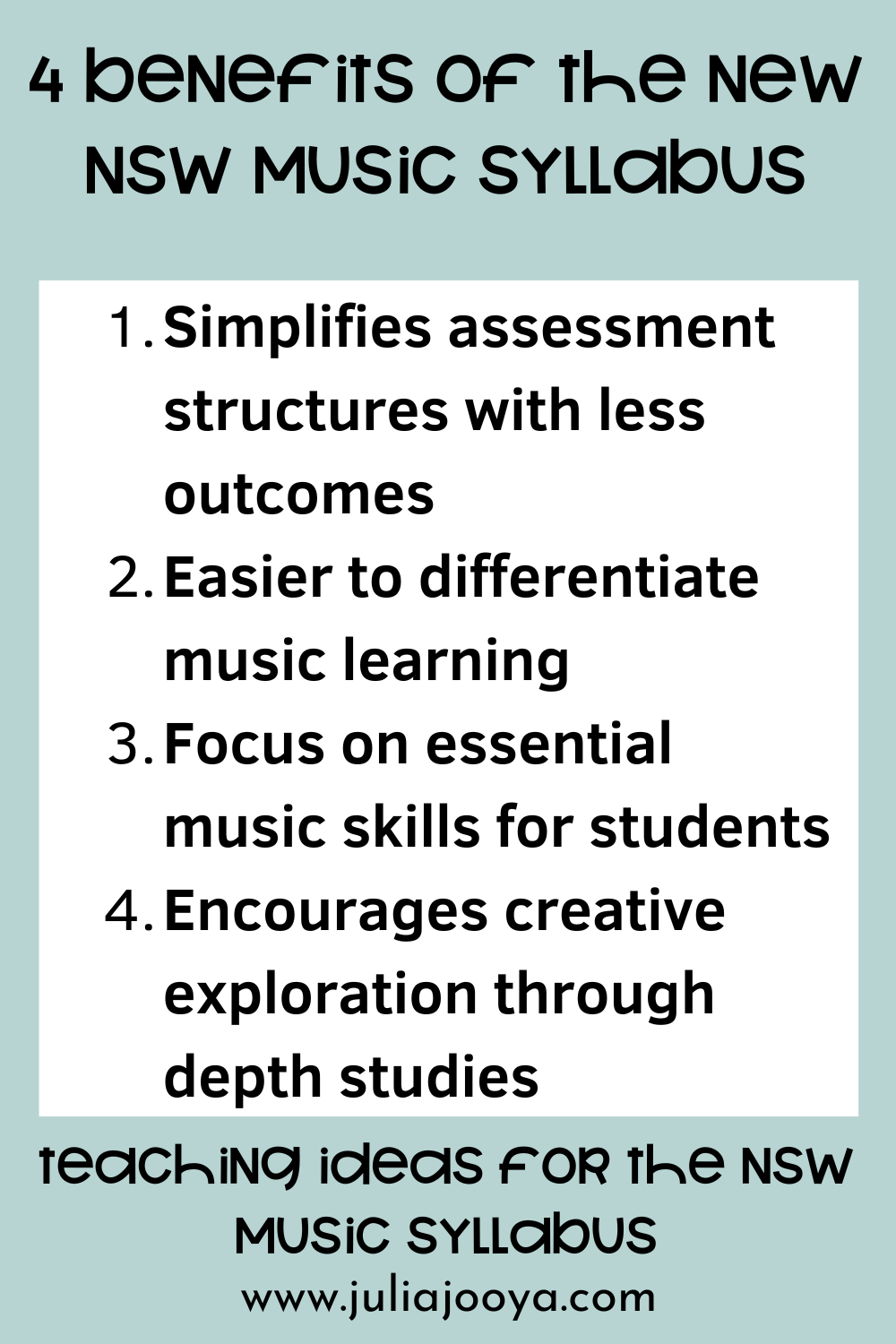
One of the most positive proposed changes in the NSW Music Syllabus is the reduction in syllabus outcomes. By streamlining learning objectives, teachers can:
- Spend less time worrying about over-complicated assessment structures.
- Better differentiate learning experiences for music students.
- Focus on developing essential skills rather than just ticking syllabus boxes.
- Provide more freedom to explore creative arts syllabus options, including depth study and project-based learning.
This shift makes it easier to adapt your music lessons to the most appropriate options for students of all abilities, including those studying Life Skills outcomes.
The 3 outcomes for Stage 4 are –
- MU4-PER-01– uses performance skills to demonstrate understanding of the elements of music and communicate musical ideas
- MU4-LIS-01 – uses listening skills to describe music in relation to stylistic, cultural, historical or social contexts and the elements of music
- MU4-COM-01 -improvises, arranges or composes using the elements of music to create musical ideas
The 6 Outcomes for Stage 5 are –
- MU5-PER-01 – performs repertoire with stylistic awareness and musical expression
- MU5-PER-02 -manipulates and combines the elements of music in performance to communicate musical ideas
- MU5-LIS-01 – uses listening skills to analyse music in relation to stylistic, cultural, historical and social contexts
- MU5-LIS-02 – uses listening skills to evaluate how the elements of music are manipulated and combined
- MU5-COM-01 – improvises, arranges or composes with stylistic understanding and musical expression
- MU5-COM-02 – manipulates and combines the elements of music to create musical ideas
If you want to access these outcomes from the NSW Curriculum site, click here
Where to Access Official Documents
To stay up to date with the NSW syllabuses, refer to these NSW Education Department resources:
- NSW Creative Arts Syllabuses
- NSW Music 7-10 Syllabus
- NSW Music Syllabus Outcomes
- NSW Music Syllabus Content
- NSW Music Syllabus Assessment
- NSW Elements of Music
These documents outline key content groups, course requirements, and curriculum options for NSW schools.

NSW 6 Elements of Music Resource Bundle
If you are a music teacher looking for a comprehensive, syllabus-aligned resource, then the 6 Elements of Music Lessons & Worksheets Bundle for the New NSW Syllabus Bundle provides everything you will need to effectively teach the 6 Elements of Music. This all-in-one bundle includes printable and digital resources, scaffolded activities, step-by-step teacher notes, and editable learning intentions and success criteria.
Each of the 6 Elements of Music is covered in detail with colourful display versions, printable teacher versions, student worksheets, guided teacher notes, differentiated activities, and listening tasks that can be used with any music selected for study. Additionally, the exclusive M.U.S.I.C. Paragraph Writing Scaffolds will help your students to develop structured responses and critical analysis skills, which is a key focus of the new syllabus.
Exclusive bonuses in this bundle include:
- 150 Pages of Rhythm Cards – Ideal for rhythm practice, composition, and group work.
- 6 Elements of Music Mind Map Versions – Visual tools to reinforce conceptual understanding.
- Listening Questions Cards (Levels 1–3) – A tiered system to build aural and analysis skills progressively.
This bundle has been designed and created by an experienced NSW music educator, making it an invaluable resource for music teachers teaching grades 7 to 10 music classes. Save yourself time, reduce stress, and provide engaging lessons with the NSW 6 Elements of Music Bundle!
Link to the 6 Elements of Music Lessons & Worksheets Bundle for the New NSW Syllabus here
Adapting to the new NSW Music Syllabus doesn’t have to be overwhelming. With the right resources, classroom teachers can confidently teach the 6 Elements of Music, support student engagement, and reduce stress in lesson planning.
Ready to simplify your lesson planning? Check out the NSW 6 Elements of Music Bundle and start teaching with confidence!
For more updates, bookmark this page and stay connected with NESA and the NSW Department of Education!
Until next time
Happy Teaching
Julia from Jooya
2 Responses